Grow Christians

Beckoned by the Holy

I love everything about this new season of Epiphany—chalking the doors, eating King Cake, wearing crowns, and reflecting on the light. I even love saying the word epiphany—a word that connotes emergence, brightness, illumination, mystery, starlight, and revelation. The season of Epiphany gives me an opportunity to talk with my boys about how the holy beckons to us—sometimes in mystical and mysterious ways—in our everyday lives.

One such epiphany I look forward to sharing with them—especially as they mature in their lives as students of text and history—happened to the singer-songwriter Elizabeth (Libbie) Schrader in 2010. Schrader was quietly praying in a Brooklyn garden she loved; the garden happened to be dedicated to the Virgin Mary. As Schrader directed her prayer toward the Virgin Mary, she heard a voice reply, “Maybe you should talk to Mary Magdalene about that.”

Surprised by the specificity of the response to her prayer, Schrader allowed herself to be beckoned by the holy down a path to the unknown. The first step she took was to write and record a gorgeous song called Magdalene. (I don’t think you’ll be sorry if you pause and take a moment to watch and listen!)

Then, Schrader allowed herself to be beckoned by the holy in a more radical way; she enrolled at General Theological Seminary and embarked on a new career path to become a textual scholar of the New Testament. She studied a transcription of the oldest copy of the Gospel of John (known as Papyrus 66), While doing so, she noticed that, in the story of Lazarus, the name Mary had been crossed out twice. The first time “Mary” was crossed out, it was replaced with “Martha.” The second time “Mary” was crossed out, it was replaced with “the sisters.”

Schrader published her findings in the Harvard Theological Review, and she has gone on to pursue doctoral work at Duke Divinity School. Her fascinating scholarship suggests that early editors of John’s gospel may have deliberately minimized Mary Magdalene’s prominence in the story. A 2021 article Schrader published in the Journal of Biblical Literature further suggests that Mary Magdalene was not from Magdala as is commonly thought; in fact, it’s unlikely “Magdala” even existed as a place near the Sea of Galilee. Schrader’s scholarship instead suggests that Mary Magdalene’s name was more of an honorific meaning “the tower” or “magnified one”—thus signaling her prominence.

“Maybe you should talk to Mary Magdalene about that” indeed!

Read more

Epiphany, Pregnancy, The Already, and the Not Yet

I always felt a little bit sorry for the liturgical season of Epiphany. Sandwiched between its higher status siblings Christmas and Lent, Epiphany sometimes feels like the middle child of liturgical seasons. The best we can offer are some mobile wise men in the weeks leading up to your one big Sunday, but please remember that’s *technically* Christmas territory.

But for me, in this season of my life, Epiphany means so much more than Christmas or Lent. Our family will welcome its fifth member this Epiphany and this idea of Christ both being revealed to the world and the world not yet being of Christ speaks to me. We are in the season of the already, but not yet. Those wise men figurines have made their way from our dining room buffet to the nativity scene on our mantle, but their journey is not yet complete. Christ has entered the world and, in the seasons ahead will grow into a curious and precocious boy in the Temple, embarrassed young adult at a wedding reception (“Mom, could you not right now?!”), teacher, healer, and ultimately Messiah. But for now, our baby Jesus lays in his tiny, ceramic manger. No one on our mantle knows the journey ahead or the way that God has already transformed the world.

In a similar way, I can point to some “already” things about our son who is due in just a few weeks. I have felt him leap in my womb, watched his small body roll across my belly, and even experienced his hiccups. The nausea of the first trimester made way for a blissful burst of energy in the second, only to be replaced with sheer exhaustion and incredible heartburn in the third. My belly has expanded, my pants no longer fit, and ultrasound technicians have methodically detailed our son’s growth. Perhaps the most touching “already” moments have been watching our two older daughters become loving big sisters.

Read more

Christ to the Nations 

A few years ago over my holiday time from work, I traveled with my family two hours south to San Diego. The city is filled with many tourist destinations— Balboa Park, the Zoo, Little Italy, Seaport Village and the Maritime Museum among others.  We made our way to the Maritime Museum and  boarded The Star of India. Built in 1863 it is the oldest active merchant sailing ship, and has made  21 circumnavigations of the world during its lifetime. I also walked down two different sets of narrow steps to tour an American and Russian submarine. The walk along the water’s edge was delightful.

My exploration continued into the area known as Seaport Village. It was there that I came upon a small religious gift shop, the many crosses displayed in the window drawing me inside.  This shop wasn’t filled with religious books as I had expected but many more crosses! Crosses of all various sizes and shapes from around the world—Celtic crosses and Spanish crosses of glass and metal and ones with small tiles set into the wood.

 As I stood looking at the array of uniquely crafted items, a woman behind me said, “Those are blessed by the priest.” I turned to see who was speaking and found a petite woman with grey hair, dressed in a light brown skirt and brown sweater and a scarf neatly organized around her head. Her accent wasn’t quite recognizable to me. Supposing she was the owner of the store sharing the tip as a selling piece, I took the information in, smiled at her, and continued on my way around the shop.

 At the counter, I asked the clerk what priest blessed the crosses, wondering if the shop was affiliated with the Episcopal Church or Roman Catholic.  She said, “I am not aware of the crosses being blessed.” And she went on to say that she did not know the woman who spoke to me but that she, herself, was the owner.  The owner told me that she had known of people buying crosses for weddings or baptisms and then having the priest bless them, but not the other way around.

Read more

Celebrating the Conversion of a Man So Sure About Everything

I’m making another king cake for the Conversion of Saint Paul. The epiphanies will keep coming, whether by guiding star or blinding light or daily bread.

A few weeks ago, my family celebrated the Feast of the Epiphany a couple of days late. We made a special meal, chalked the entrance to our house, and ate great big slices of the king cake I had baked, and which my children had iced with the characteristic gusto of the elementary set. 

We moved the feast, though, from its usual spot. January 6 had been a jarring day as events in Washington DC unfolded, and that evening the church where I serve offered a virtual prayer vigil. The clergy masked up and sat distanced in our sanctuary, interspersing long stretches of silence with prayer and scripture readings and a gentle guitar. It was exactly where I needed to be. We heard from people later that they too were glad for the refuge—that they had needed to breathe in and breathe out, to be still and know God.

The vigil was streamed in the usual places people can encounter our parish worship, including on social media. There was something we liked about the idea that one’s scrolling could be interrupted by an invitation to pray. Throughout the afternoon, I had been reading and reading the news and somehow expecting it would be different in the next article I clicked through to. I know I needed an interruption—not as an escape from reality, but as a means of grounding myself in the deepest reality I know. The faithfulness of God, who begins and ends in love.

It felt important to me to “do Epiphany” with my kids, even if we did it late—to help them encounter through the story and rituals of the day something of that God who interrupts and sends us by another way. Who reveals our blindness, where we thought we saw everything with such clarity.

Saul, who would later become known as Paul, was born into a Jewish family in Tarsus. He was passionately upright in his observance of the law, and first regarded the Christian movement as a dangerous development. We know from the Acts of the Apostles that he witnessed and approved of the stoning of Stephen, the first martyr of the early resurrection community. He was known and feared among early Christians for his fervor in persecuting them. 

Read more

A Journey with John

This is the condemnation – that Light is come into the world, and men loved darkness rather than Light because their deeds were evil. —John 3:19

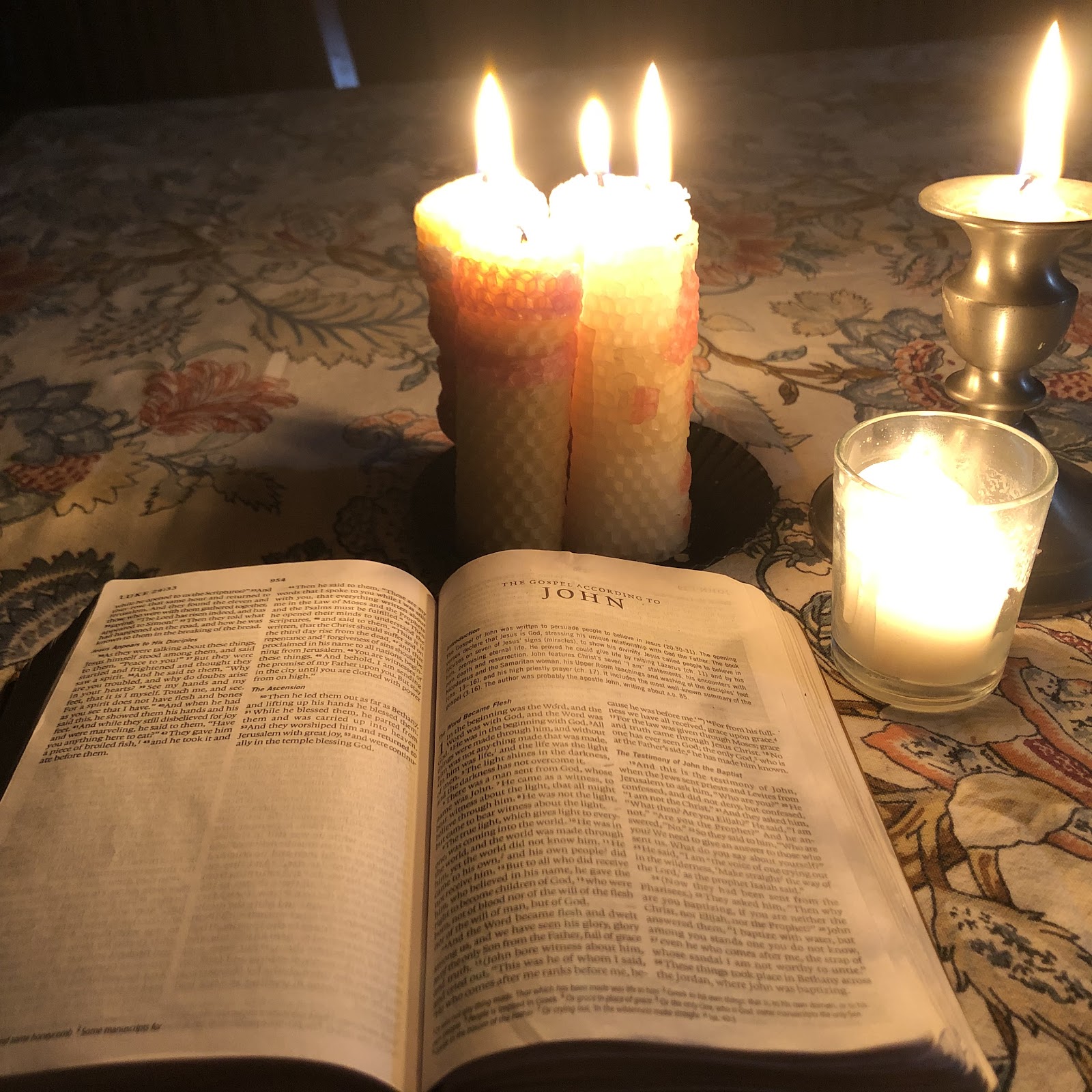
The image of light in John’s gospel has lingered with me in my days over the past few weeks. In this darkest, coldest moment of our Wisconsin winter, the image of light is particularly alluring. As parents we deal daily with the darkness that pulls our children toward it. Their attitude towards reading scripture, the things they are drawn to in culture, and their sinful natures that cause typical sibling strife and relational struggle are all real.

But, then there are the moments where the Light breaks through. The moment when the cranky teen makes insightful and loving commentary on the nightly passage, the action by a middle boy that he connects to truth he has read, and the moment when the littlest stands wondering at God’s goodness as he ponders a piece of nature all happen, too. And I remember that the Light is so much greater than the darkness.  There is more light than there is darkness. I remember that we are children of light and that we have pledged our children to the light at baptism.

Read more

A Hope-Sustaining and Lovely Time with the Good Book Club

Six weeks ago, I sat down to write in this space about getting ready to read daily scripture together for the season of the Epiphany in “The Good Book Club.” While I was pretty clear with myself that I didn’t think it would be an easy practice to take on reading daily scripture together, I was hopeful. And, in fact, it has been a hope-sustaining and lovely time. 

By the numbers: at about a week away from the end (50 days) we are at day 26. So just over 50%. There were weeks we didn’t miss a day, and probably there were times we skipped four in a row. An average of every other day seems just fine to me.

On a practical level: the times we made it work the best were when we ate dinner all together and read at the table. I can think of several times when someone was rushing off to basketball practice or a meeting. Just sitting together at the table for any length of time was the miracle of the day, and reading scripture on top of it would have just been more than we could ask.

Our kids generally attend church at my husband’s congregation, where their Sunday school and confirmation classes are reading John as well, so that support helped us when our energy flagged. Not a surprise—community matters! Whatever we each thought of the practice at any given time, knowing that other kids and other parents were doing the same thing was definitely a help for us all. The competition for the Sunday school class with the highest participation earning a party didn’t hurt either.

Read more